
If you come from the world of data and analytics the term "context layer" probably sounds familiar. It might even sound like something you already have: a semantic layer.
It's a reasonable assumption. Both concepts sit between raw data and the applications that consume it. Both aim to make information more accessible and usable. But they were designed for fundamentally different eras of enterprise technology, and confusing them is one of the most common reasons AI initiatives stall.
Here's the short version: a semantic layer makes structured data understandable to BI tools. A context layer makes all enterprise data — structured and unstructured — usable by AI agents. If your ambition is dashboards and reports, the semantic layer has you covered. If your ambition is AI that can reason over what your organization knows, you need something new.
What is a semantic layer?
A semantic layer is an abstraction that translates raw database schemas into business-friendly metrics and definitions. It sits between your data warehouse and your BI tools, mapping cryptic column names like txn_amt and cust_id to terms like "Transaction Amount" and "Customer ID" — so business users can query data without writing SQL or understanding table joins.
The semantic layer was born in 1991, when Business Objects introduced a metadata layer that let business users query relational databases directly. Before that, if a marketing director wanted to see quarterly revenue by region, they submitted a request to a database administrator and waited. The semantic layer eliminated that bottleneck.
Through the 1990s and 2000s, every major BI vendor built their own version — Cognos, MicroStrategy, Hyperion — each tightly coupled to its visualization tool. The concept worked brilliantly but created silos: your Cognos semantic layer couldn't talk to your Business Objects semantic layer, so metric definitions diverged across tools.
The modern resurgence came in 2021, when dbt Labs declared that "dbt should know about metrics." By 2023, dbt had acquired Transform and its MetricFlow engine, making the semantic layer a first-class concern of the modern data stack. The thesis was compelling: define your metrics once in dbt, and serve consistent KPIs to every downstream tool — Tableau, Looker, Power BI, Python notebooks. Snowflake, Databricks, and others quickly followed with their own semantic layer capabilities.
Today, the semantic layer is widely recognized as essential infrastructure for analytics. Gartner elevated it to "essential infrastructure" in its 2025 BI & Analytics Hype Cycle. And for its intended purpose — governing structured data for dashboards and reports — it works exactly as designed.
What is a context layer?
A context layer is infrastructure designed to make all enterprise data — structured and unstructured — usable by AI agents and applications. Where a semantic layer answers "what does this metric mean?", a context layer answers a broader set of questions: What information is relevant to this task? What rules and constraints apply? What precedents exist? How should the AI use this knowledge to produce an accurate, grounded response?
The distinction is easiest to see through an example.
A semantic layer tells an AI system that "enterprise customer" means accounts with contracts above $100K annually. Useful. But a context layer goes further — it provides the AI agent with the actual contract terms for that customer, the relevant product documentation, the history of prior support interactions, and the domain-specific rules that govern how to respond. The semantic layer provides a definition. The context layer provides the organizational intelligence needed to act correctly.
Under the hood, a context layer typically combines several capabilities that don't exist in traditional analytics infrastructure: document processing pipelines that extract structure from PDFs, images, and complex technical documents; retrieval systems (often called RAG — Retrieval-Augmented Generation) that find the most relevant information across massive document collections; and grounding and attribution mechanisms that ensure AI responses are traceable back to specific source documents.
For the data leader more comfortable with warehouses than vectors, here's the simplest mental model: a semantic layer is to structured data what a context layer is to all enterprise data. The semantic layer sits between your warehouse and your BI tools. The context layer sits between your entire knowledge base and your AI agents.

Structured vs. unstructured data: where the semantic layer hits its limit
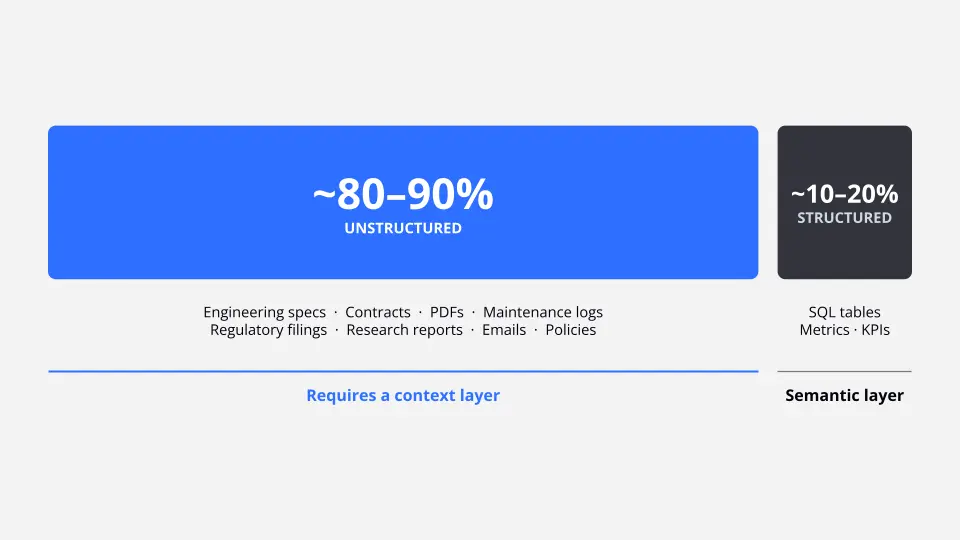
The semantic layer was built for a world of rows and columns. It assumes data lives in structured schemas — fact tables, dimension tables, star schemas, SQL-queryable warehouses. This works brilliantly for ensuring "Revenue" means the same thing in every report and "Active Customer" has one consistent definition.
But most enterprise knowledge doesn't live in rows and columns.
Industry estimates consistently put unstructured data at 80–90% of all enterprise information. These are the engineering specifications, legal contracts, regulatory filings, maintenance logs, research reports, customer correspondence, and internal policies that contain the vast majority of what an organization actually knows. This is the data that your subject-matter experts spend hours manually searching, reading, cross-referencing, and synthesizing every day.
A semantic layer cannot process a 200-page engineering specification. It cannot analyze a contract to determine whether a clause conflicts with a new regulation. It cannot reason across a set of earnings call transcripts to identify shifts in competitive strategy. These aren't edge cases — in industries like semiconductors, energy, manufacturing, and financial services, this is the core work.
The semantic layer answers questions like "What was Q3 revenue by product line?" It was never designed to answer questions like "Based on our test logs, datasheets, and prior failure analyses, what is the most likely root cause of this device failure?"
Where each layer wins: concrete use cases
The boundary between these two layers becomes clearest through real-world use cases.
The semantic layer excels at consistent KPI reporting across BI tools, self-service analytics with governed metric definitions, text-to-SQL interfaces where natural language questions return structured data answers, and any workflow where the underlying data is tabular and SQL-queryable. If the question can be answered with a SQL query, the semantic layer is the right tool.
The context layer becomes necessary when AI must reason over complex, unstructured, multi-document knowledge. This includes AI agents that resolve technical issues by searching across datasheets, application notes, and prior tickets — compressing what used to take an engineer 8 hours into 10 minutes. It includes compliance workflows where AI cross-references contracts against regulatory frameworks. It includes financial analysis that requires synthesizing earnings transcripts, SEC filings, and research reports. And it includes any use case where the answer isn't in a database table — it's buried across dozens or hundreds of documents that a human expert would normally spend hours reviewing.
Consider a semiconductor company. A semantic layer helps the finance team see consistent revenue metrics across business units — that's valuable. A context layer helps a customer engineer resolve a complex technical issue in minutes instead of hours, by giving an AI agent access to the right datasheets, application notes, and internal knowledge, with full traceability to source documents — that's transformative.
Or consider a legal team. A semantic layer might track contract values and renewal dates in a structured system. A context layer enables an AI agent to actually read those contracts, identify conflicting clauses, cross-reference against new regulations, and surface risks with citations a lawyer can verify.
These aren't competing priorities. They're different layers of the stack, solving different problems.
| Semantic layer | Context layer | |
|---|---|---|
| Purpose | Translate structured data for BI tools | Make all data usable by AI agents |
| Data types | Structured (tables, rows, columns) | Structured + Unstructured (docs, specs, contracts, tables) |
| Answers | "What does this metric mean?" | "How should AI use this knowledge to act correctly?" |
| Consumers | Analysts, dashboards, BI tools | AI agents, copilots, automated workflows |
| Examples | Consistent KPI reporting; Text-to-SQL queries | Root cause analysis across docs; Contract compliance review |
| Key tech | dbt, LookML, Cube, Snowflake Semantic Views | RAG, document processing, grounding & attribution |
Why this distinction matters now
The reason this distinction has become urgent is straightforward: enterprises are being asked to deploy AI that goes far beyond what BI infrastructure can support.
The data teams tasked with enabling these initiatives are discovering that their existing infrastructure — data warehouses, ETL pipelines, semantic layers, BI tools — was built for a different job. It was built for human-speed, dashboard-based analysis of structured data. Production-grade AI agents need something categorically different: the ability to process unstructured data at scale, retrieve the right information in real time, and ground every response in verifiable source documents.
This is not about replacing the semantic layer. The investments data teams have made in metric governance, consistent KPI definitions, and structured data quality remain foundational. But they are one layer in a larger architecture. The organizations that will succeed in deploying production-grade AI are those building the complementary context layer: document processing, retrieval systems, grounding and attribution, and the orchestration that ties it all together.
The semantic layer was the bridge from databases to dashboards. The context layer is the bridge from dashboards to AI agents that can actually reason over the full breadth of what an organization knows.
Frequently asked questions
Is a context layer a replacement for a semantic layer? No. A context layer complements a semantic layer. The semantic layer remains essential for governing structured data and ensuring consistent metric definitions across BI tools. The context layer extends that foundation to unstructured data — documents, specifications, contracts, and other complex content — so AI agents can reason over everything an organization knows, not just what lives in a data warehouse.
Can a semantic layer support AI use cases? Yes, for a specific subset. Semantic layers are increasingly valuable for text-to-SQL interfaces, where an AI system translates natural language questions into structured queries. For anything involving structured, tabular data, a semantic layer significantly improves AI accuracy. But for use cases that require reasoning over unstructured documents — engineering specs, legal contracts, research reports — a semantic layer alone is insufficient.
What is context engineering? Context engineering is the discipline of designing systems that provide AI models with the right information, in the right format, at the right time. It encompasses how enterprise data is processed, retrieved, and delivered to AI agents so they can produce accurate, grounded, and useful responses. A context layer is the infrastructure that makes context engineering possible at enterprise scale.
What types of organizations need a context layer? Any organization deploying AI agents that need to reason over proprietary, unstructured data. This is especially critical in technical industries — semiconductors, manufacturing, energy, aerospace, financial services, legal — where the most valuable organizational knowledge lives in complex documents rather than database tables, and where accuracy is non-negotiable.
What is RAG, and how does it relate to a context layer? RAG (Retrieval-Augmented Generation) is a technique that grounds AI responses in actual enterprise documents rather than relying solely on a model's training data. RAG is a core component of a context layer — it's the mechanism that retrieves relevant information from your knowledge base so the AI can reason over it. A context layer provides the full infrastructure around RAG: document processing, grounding, attribution, and enterprise-grade security and governance.
Related Articles

Demystifying Agent Memory

Making ACE Work in Production: Two Lessons from the Real World
Making Search Agents Faster and Smarter
Optimize your search agents for speed and accuracy. Our two-axis approach—reranker improvements and RL-trained planners—reaches 60.7% accuracy.